Quick answer
The fastest way to teach kids water conservation is to make the invisible visible: the EPA's free WaterSense Kids game turns household water use into a hands-on challenge, guiding Flo through pipes while dodging "water wasters." Pair five minutes of play with one follow-up question about your own home's faucets and showers, and the lesson transfers straight into daily habits. Below are 5 ready-to-run sessions.
Water is a strange topic for kids because, unlike a pile of trash, wasted water is invisible the moment it goes down the drain. There's no growing mountain to point at, no obvious pile of consequences. That's exactly why water conservation needs games more than most eco topics — a game can make an invisible habit feel like a visible choice with a visible score.
That's the whole idea behind this guide. Not another list of "top 10 educational games" you'll scroll past — five specific play sessions, mixing HelloHiDear's habit-building games with the best free water-specific tools from EPA and USGS, each with an age range and a script for the two minutes of talking that makes it stick.
Why water conservation is harder to teach than it sounds
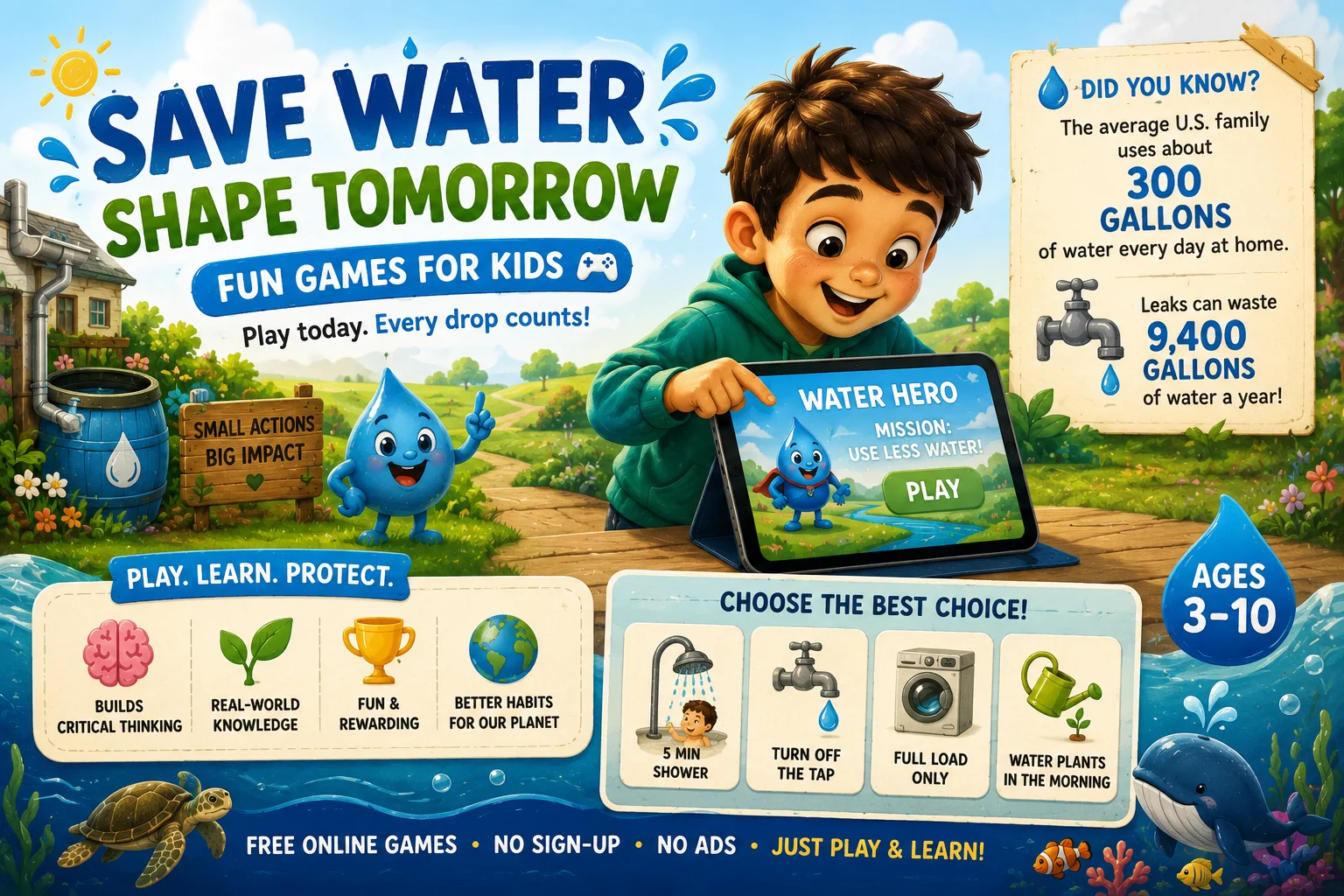
Most kids have never seen a water bill, so "save water" can feel like an abstract instruction with no visible payoff. Concrete numbers close that gap fast.
82 gal
used per person, per day, at the average American home
~300 gal
used daily by the average family of four in the U.S.
70%
of household water use happens indoors, not on the lawn
9,400 gal
wasted yearly by the average family from undetected leaks alone
Figures reflect EPA WaterSense and USGS household water-use estimates commonly cited as of 2026; actual use varies by region and household size.
The leak number is the one worth repeating to kids: a running toilet can waste around 200 gallons a day, all by itself, without anyone ever touching a faucet. That's the fact that turns "turn off the tap while brushing your teeth" from a chore into a detective mission — kids genuinely enjoy hunting for leaks once they know what they're worth.
You can't see wasted water pile up the way you can see a trash can fill up — which is exactly why this topic needs a game more than most.
5 free play sessions, ranked by age
Each of these is a full session: 4–10 minutes of play, plus a conversation starter you can use word-for-word. Start with whichever one matches your kid's age, then work down the list over a few days.
1. Test Your WaterSense — the flagship
In this free EPA game, kids guide Flo, the water-efficiency hero, through a maze of pipes, answering water-use questions correctly to avoid being caught by water-wasting monsters. It's built specifically to teach water conservation, which makes it the strongest starting point on this whole list.
Play Test Your WaterSense free →
2. USGS's interactive water cycle — the "where does it all go" session
Conservation makes more sense once a kid understands that water is a cycle, not an endless supply. This free interactive diagram from the U.S. Geological Survey lets kids click through evaporation, condensation, and collection at their own pace.
Explore the USGS water cycle diagram →
3. Landfill Lifter — the habit-building bridge
Water conservation and waste habits share the same underlying skill: noticing everyday choices that quietly add up. This HelloHiDear game isn't about water directly, but it's a great bridge session for building the general "small choices, big totals" mindset this whole topic depends on.
Play together, no download needed
Build the whole eco-habit shelf, not just one game
Water conservation sticks best alongside the rest of the habit-building picture. HelloHiDear's free Waste & Recycling series covers the trash side of that same "small choices add up" lesson, for kids ages 5–10. No account, no ads between rounds, just play.
Browse the full games library →4. Reflection Reject — a water-themed brain break
To be upfront: this HelloHiDear game doesn't teach conservation directly — it's a visual pattern game set around a puddle's reflection. But it's a genuinely fun, water-themed way to close out a session, especially after a couple of fact-heavy rounds above.
5. Water Use It Wisely's kid activities — the take-home tip session
This free nonprofit hub collects several short water-conservation games and a running list of practical, kid-friendly tips, making it a good "one more round" option once the EPA and USGS sessions above are done.
Explore Water Use It Wisely's kid activities →
Screen game vs. craft vs. story: which fits your kid
Water conservation is one of the easiest topics to turn into a real household habit, not just a game. Here's how to match the format to your kid's attention span this week.
| Format | Best for | Time needed | Where to start |
|---|---|---|---|
| Online game | Kids who want quick wins and instant feedback | 4–10 min | EPA WaterSense Kids |
| Leak-detective mission | Turning the lesson into a real household task | 10–15 min | Check toilets for leaks with a drop of food coloring in the tank, no flushing |
| Timed shower challenge | Making conservation feel like a game at home | 5 min/day | Build a 2–3 song playlist and see if the shower ends before it does |
| Bedtime conversation | Reinforcing what a game already taught | 2–5 min | Use the "ask after playing" scripts above |
If you only have five minutes today, the EPA game wins every time — it was built for exactly this. But water conservation is one of the rare eco topics where the offline version (an actual leak hunt) can be just as fun as the game, so don't skip it once your kid is hooked.
- 💧 Start with the EPA WaterSense game — it's purpose-built for this exact topic.
- 💧 Say the follow-up question out loud, even if the answer is "I don't know." That's still the conversation working.
- 💧 Turn one fact — like the toilet-leak number — into a real at-home mission this week.
- 💧 Let a lighter, water-themed game close things out so kids don't associate learning with feeling bad.
Parent FAQ
What age should kids start learning about water conservation?
Around age 6 or 7 is when kids can connect an everyday action, like a running faucet, to a bigger idea like a household water bill or a leak. Simple interactive games work well for ages 5 to 10, with older kids able to handle more detailed water-use quizzes.
How much water does a typical household actually use?
The EPA estimates the average American uses about 82 gallons of water per day at home, and the average family of four uses roughly 300 gallons a day, with about 70% of that used indoors.
What's the single biggest water waster in most homes?
Household leaks are a major culprit — the EPA estimates the average family wastes about 180 gallons a week, or roughly 9,400 gallons a year, just from undetected leaks like a running toilet.
Are these water conservation games free with no sign-up?
Yes. The EPA's WaterSense Kids game and USGS's water cycle diagrams are free federal resources, and every HelloHiDear game linked in this guide also plays free in a browser with no account required.
Written by the HelloHiDear editorial team, who build and test every free game linked on this site. Water-use stats reviewed against publicly available EPA and USGS data as of July 2026. See something outdated? Let us know.