Quick answer
Sorting games teach kids the exact skill most adults get wrong at home: deciding, quickly and correctly, which bin something belongs in. HelloHiDear's free Landfill Lifter is a fast-paced sort-under-pressure game that mirrors real recycling decisions. Pair five minutes of play with one follow-up question and the skill transfers straight to your actual kitchen bins. Below are 5 ready-to-run sessions.
Here's an uncomfortable fact for grown-ups: most of us aren't actually great at sorting our own trash. We toss in a greasy pizza box hoping it counts, or a plastic bag we're "pretty sure" is recyclable. Kids pick up these habits by watching, which means the earlier they learn a confident, correct sorting instinct, the better it sticks — for them and, honestly, for the household.
That's the whole idea behind this guide. Not another list of "top 10 educational games" you'll scroll past — five specific play sessions, each built around a real free game, an age range, and a script for the two minutes of talking that turns fast clicking into a real habit.
Why sorting is a bigger deal than it sounds
Sorting seems like a small, almost boring skill — until you look at how often adults get it wrong. A confident, well-practiced kid sorter can genuinely improve what a household actually recycles.
~25%
of items placed in household recycling bins are actually contaminants
21%
of U.S. residential recyclables are estimated to actually get captured
76%
of recyclables are estimated to be lost to trash before reaching a facility
$1B+
lost annually by the U.S. recycling industry due to contamination
Figures reflect recycling-industry and Recycling Partnership research commonly cited as of 2026; contamination rates vary by municipality.
The behavior behind most of that contamination even has a name: "wishcycling" — tossing something in the recycling bin because you hope it's recyclable, not because you know it is. It's well-meaning, but a single contaminated batch can send an entire truckload of good recyclables straight to a landfill. Sorting games are, in a very real sense, wishcycling prevention training.
A kid who can confidently sort ten items into the right bin is quietly better at recycling than most adults.
5 free play sessions, ranked by age
Each of these is a full session: 4–7 minutes of play, plus a conversation starter you can use word-for-word. Start with whichever one matches your kid's age, then work down the list over a few days.
1. Landfill Lifter — sort fast, sort right
This free browser game has kids crush non-recyclable waste while saving recyclables under time pressure — which is closer to real sorting than a slow, careful matching game. Speed sorting under a little pressure is exactly the skill that makes a kid confident at the actual kitchen bin.
Play together, no download needed
Turn this into your kid's go-to sorting shelf
Landfill Lifter is one game in HelloHiDear's free Waste & Recycling series — short, browser-based games that build real sorting and classification skills for kids ages 5–10. No account, no ads between rounds, just play.
Browse the full games library →2. Electronic E-Waste — sorting in the right order
This one adds a twist most sorting games skip: order matters, not just category. Kids have to remove battery, then metals, then plastic — in that sequence — which teaches a more advanced kind of sorting logic than a simple two-bin game.
Play Electronic E-Waste free →
3. Biodegradable Bubble — sorting by speed, not category
Instead of sorting into bins, kids rank four items — a cotton shirt, an apple core, a banana peel, a newspaper — from fastest to slowest to decompose. It's a different flavor of sorting (ordering rather than categorizing) that stretches the same underlying skill in a new direction.
Play Biodegradable Bubble free →
4. NOAA's marine debris puzzles — sorting, science-agency style
NOAA's free kids' hub includes sorting and matching puzzles built by the actual U.S. agency that studies ocean debris — a good "leveled-up" session once your kid has the basics down from the games above.
Explore NOAA's ocean kids hub →
5. Reflection Reject — sorting by eye, not category
This one isn't about trash at all — it's spotting the single wrong reflection in a puddle full of correct ones. It still exercises the same "does this belong or not" muscle as a sorting game, just in a lighter, purely visual form. A good closer after a few rounds of recycling-focused play.
Screen game vs. craft vs. story: which fits your kid
Sorting is one of the easiest skills to practice offline too. Here's how to match the format to your kid's attention span this week.
| Format | Best for | Time needed | Where to start |
|---|---|---|---|
| Online game | Kids who want quick wins and instant feedback | 4–10 min | HelloHiDear games |
| Real bin sort | Turning practice into a genuine household habit | 5 min | Let your kid sort tonight's recycling before it goes out, no correcting mid-sort |
| Kitchen-table craft | Younger kids (ages 4–6) or hands-on learners | 15–20 min | Sort a mixed pile of clean household items into labeled boxes by material |
| Bedtime conversation | Reinforcing what a game already taught | 2–5 min | Use the "ask after playing" scripts above |
If you only have five minutes today, the online game wins every time. But the real payoff comes when a kid sorts something correctly in real life without being asked — that's the actual finish line for this whole topic.
- 🧩 Let your kid sort first, then check their work — correcting mid-sort undercuts the confidence you're building.
- 🧩 Say the follow-up question out loud, even if the answer is "I don't know." That's still the conversation working.
- 🧩 Rotate between category-sorting and order-sorting games — they use slightly different thinking.
- 🧩 Hand your kid the real recycling bin once a week. That's the actual test.
Parent FAQ
What age can kids start playing sorting games?
Simple two-category sorting (recycle vs. trash) works from about age 5. By ages 7 to 10, kids can handle faster, multi-category sorting and even ordering tasks, like ranking items by how long they take to break down.
Why does sorting waste correctly actually matter?
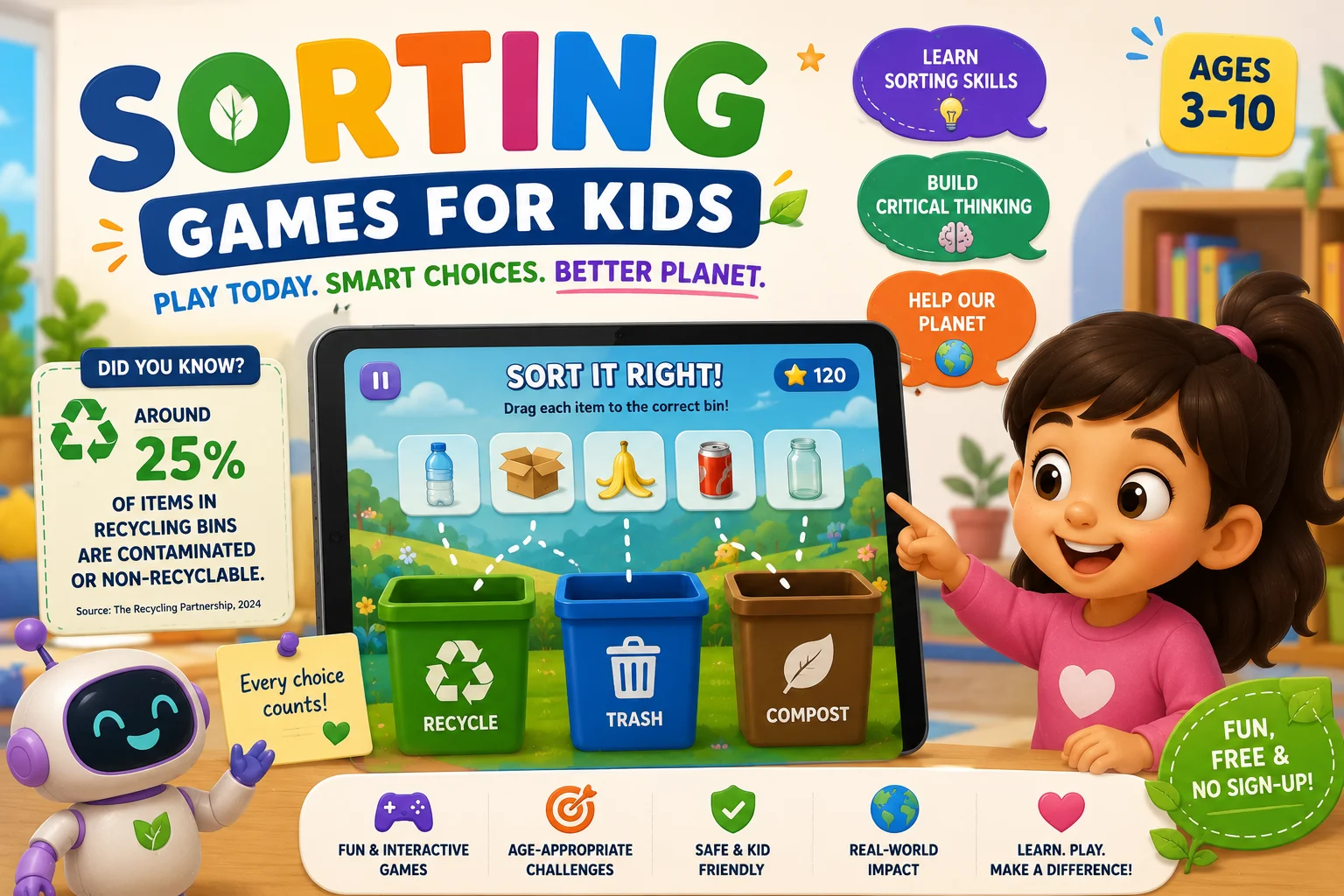
Roughly 1 in 4 items placed in household recycling bins is contaminated or non-recyclable, a behavior often called "wishcycling." A contaminated load can force an entire batch of otherwise-good recyclables to be landfilled instead.
Are sorting games actually good for kids beyond recycling?
Yes. Sorting and categorizing is a foundational cognitive skill tied to early math and reading readiness, so a recycling-sorting game is doing double duty: building real-world eco habits and general classification skills at the same time.
Are these sorting games free with no sign-up?
Yes. Every HelloHiDear game linked in this guide plays free in a browser with no account or download required.
Written by the HelloHiDear editorial team, who build and test every free game linked on this site. Stats reviewed against publicly available recycling-industry research as of July 2026. See something outdated? Let us know.