Quick answer
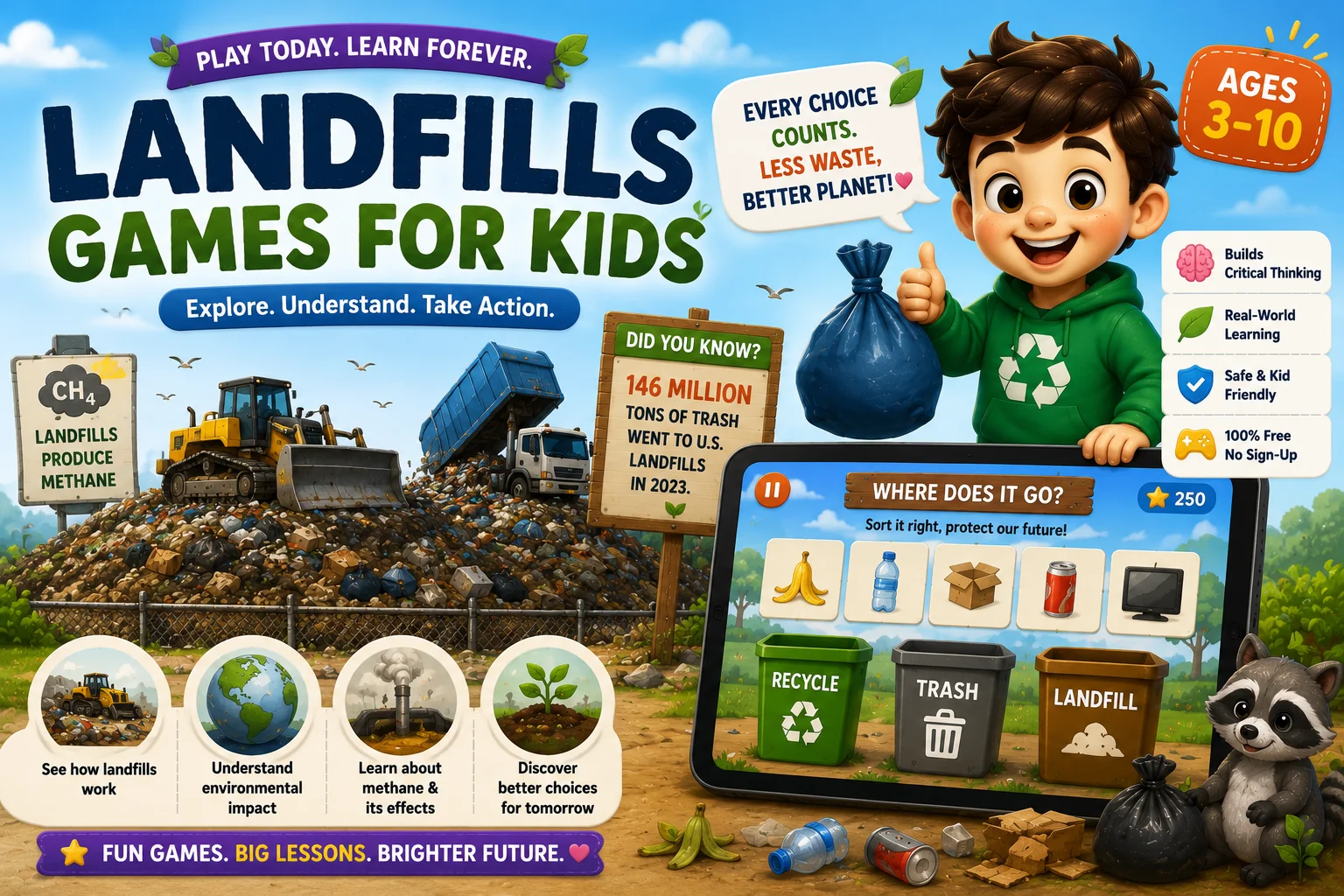
The best way to teach kids what a landfill actually is: let them run one for a few minutes. HelloHiDear's free Landfill Lifter puts kids in charge of a real construction-site landfill, crushing waste and protecting soil health in real time. Pair five minutes of play with one follow-up question and the concept — "trash doesn't disappear, it goes somewhere" — sticks fast. Below are 5 ready-to-run sessions.
Most kids have a hazy, slightly wrong idea of what happens after the garbage truck drives away. Some think it goes straight to a recycling plant. Some think it just... goes away. Almost none of them picture the truth: a real, specific place, getting a little bit bigger every single day, for decades.
That gap is exactly what a good landfill game closes — fast, and without a lecture. Below are five specific play sessions, each built around a real free game, an age range, and a script for the two-minute conversation that turns clicking into understanding.
Why landfills are a surprisingly good topic for kids
Landfills are one of the few environmental topics kids can picture almost immediately once you give them a number or two — a full landfill is basically a giant, unfun mountain, and kids are very good at understanding "mountain that shouldn't be there."
146M
tons of trash sent to U.S. landfills in the most recent EPA count
2,600+
active municipal landfill sites across the United States
~24%
of everything in a landfill is food that could have been composted
#3
largest human-caused source of methane in the U.S. is landfills
Figures reflect the U.S. EPA's most recent national municipal solid waste accounting, commonly cited by environmental researchers as of 2026.
Here's the detail that makes landfills click for a kid: almost a quarter of what's in there is food. Not old TVs, not tires — banana peels, leftover dinner, apple cores. That's the fact that turns "landfills are bad" into something a kid can actually act on, because food scraps are the one landfill ingredient a family can directly control.
A landfill isn't a magic hole where trash disappears — it's a place that remembers everything you put in it, some of it for centuries.
5 free play sessions, ranked by age
Each of these is a full session: 5–10 minutes of play, plus a conversation starter you can use word-for-word. Start with whichever one matches your kid's age, then space the rest out over the week rather than running all five back to back.
1. Landfill Lifter — run the landfill yourself
This free browser game drops kids straight into the job: crush non-recyclable waste at a construction site while keeping the soil healthy underneath. It's the single most direct way to show a kid what a landfill operator actually does, and why the "save" pile matters as much as the "crush" pile.
Play together, no download needed
Landfill Lifter is just the start of the shelf
It's one game in HelloHiDear's free Waste & Recycling series — short, browser-based games built to connect trash, recycling, and everyday habits for kids ages 5–10. No account, no ads between rounds, just play.
Browse the full games library →2. Electronic E-Waste — the stuff that shouldn't be there at all
Some of the most dangerous landfill contents aren't food or plastic — they're batteries and old electronics, which can leak chemicals into the soil for years. This game has kids safely disassemble old devices in the correct order, battery first, which is exactly the habit that keeps e-waste out of a landfill in the first place.
Play Electronic E-Waste free →
3. Biodegradable Bubble — what actually breaks down in there
Kids order items — a cotton shirt, an apple core, a banana peel, a newspaper — from fastest to slowest to decompose. It's the perfect follow-up to Landfill Lifter, because it answers the question that game leaves open: once something's buried, does it ever actually go away?
Play Biodegradable Bubble free →
4. Upcycle Workshop — the landfill detour
Every item a kid manages to turn into something new in this HelloHiDear game is one less item headed for a landfill pile. It's a lighter, more creative session than the others — a good one to run after a few rounds of "trash and consequences" games, since it ends on making something rather than sorting something.
5. Reflection Reject — a calm wind-down round
Not every session needs to be about trash. This quick pattern-spotting game is a good closer — a lower-stakes way to end after several rounds of talking about landfills, methane, and where things go. Kids process heavier topics better with a breather in between.
Screen game vs. craft vs. story: which fits your kid
Landfills are a topic that works in more than one format. Here's how to match the format to your kid's attention span this week.
| Format | Best for | Time needed | Where to start |
|---|---|---|---|
| Online game | Kids who want quick wins and instant feedback | 4–10 min | HelloHiDear games |
| Kitchen-table sort | Younger kids (ages 4–6) or hands-on learners | 10–15 min | Sort tonight's trash into "food," "recycle," and "landfill" piles together |
| Field trip | Kids who learn best by seeing the real thing | 30–45 min | Many local waste authorities offer transfer-station tours — check your city's site |
| Bedtime conversation | Reinforcing what a game already taught | 2–5 min | Use the "ask after playing" scripts above |
If you only have five minutes today, the online game wins every time. But if your kid finished a session and still has questions, that's your cue to move down the table, not repeat the same game twice.
- 🗑️ Start with Landfill Lifter — it's the clearest, most direct picture of what a landfill actually does.
- 🗑️ Say the follow-up question out loud, even if the answer is "I don't know." That's still the conversation working.
- 🗑️ Let a lighter game close out a heavier topic so kids don't associate learning with feeling bad.
- 🗑️ Point out food waste specifically — it's the one landfill ingredient a kid can actually help reduce at home.
Parent FAQ
What age should kids start learning about landfills?
Around age 6 or 7 is when most kids can grasp that trash goes somewhere specific after the truck picks it up, rather than just disappearing. Games that show a landfill filling up in real time make the idea concrete for ages 7 to 10.
How much trash actually goes to landfills every year?
In the most recent EPA national accounting, U.S. households and businesses sent about 146 million tons of municipal solid waste to landfills in a single year, out of roughly 292 million tons generated overall.
Why do landfills matter for climate change, in kid-friendly terms?
When food and other organic waste breaks down without air inside a landfill, it releases methane — a gas that traps heat in the atmosphere. The EPA lists municipal landfills as the third-largest human-related source of methane in the country, which is a useful, concrete fact for older kids.
Are these landfill games free with no sign-up?
Yes. Every HelloHiDear game linked in this guide plays free in a browser, with no account or download required.
Written by the HelloHiDear editorial team, who build and test every free game linked on this site. Stats reviewed against publicly available EPA waste data as of July 2026. See something outdated? Let us know.