🔌 Here's the short version
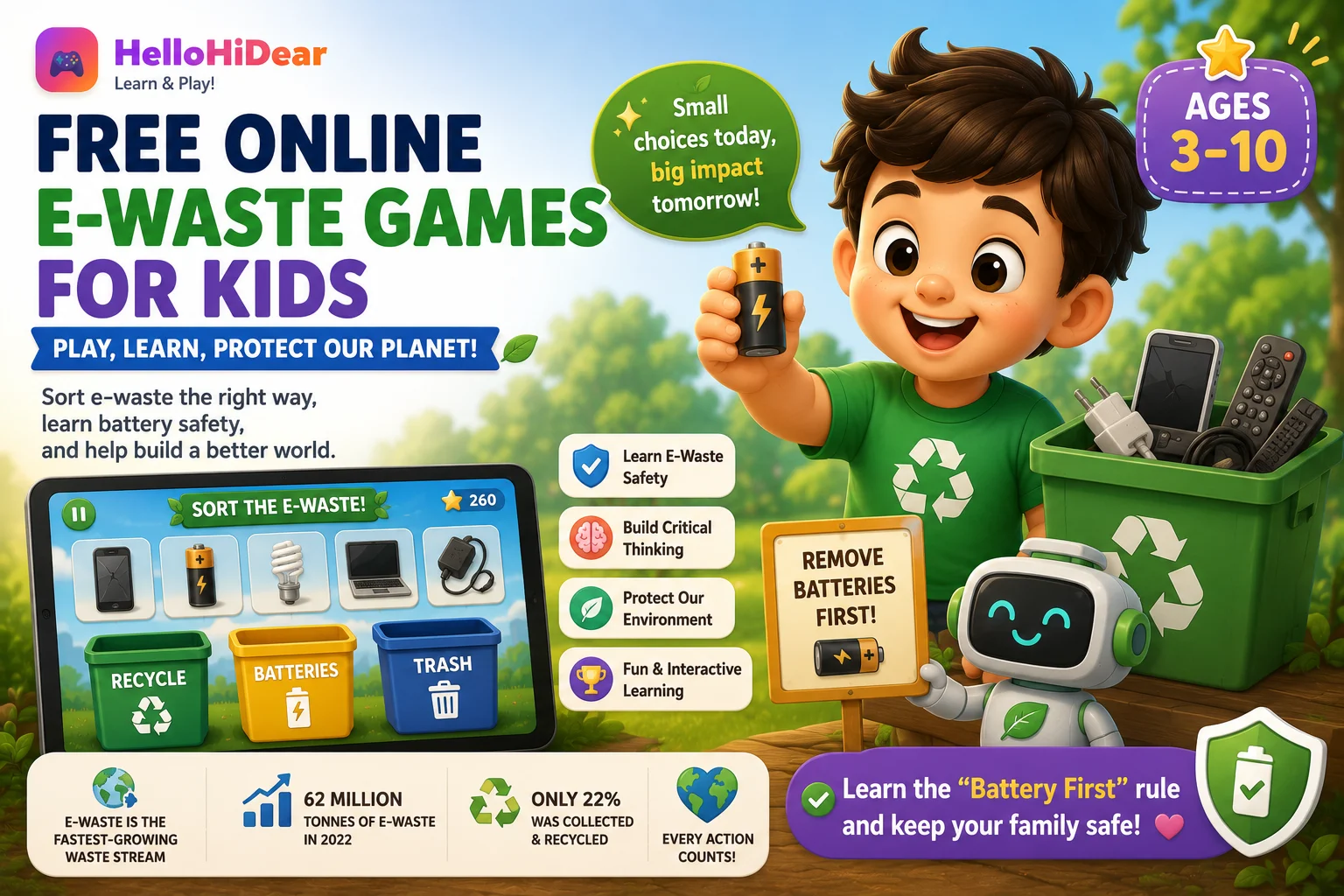
E-waste is genuinely one of the fastest-growing waste problems in the world, so games that teach kids to sort it are worth the screen time. But the part worth paying closest attention to isn't the sorting — it's the "battery first" rule. Button batteries send tens of thousands of young kids to poison control every year, almost always from ordinary household items. A good e-waste game builds that habit early. Real batteries at home should still always be handled by an adult.
Just want the game? Jump straight to it →Why e-waste is a bigger deal than most parents realize
E-waste is any device with a plug or a battery that got thrown away — phones, toys, hearing aids, that busted tablet in the junk drawer. It's the fastest-growing waste category on Earth, and it's not close.
62M tonnes
of e-waste generated globally in 2022 — up 82% since 2010
Source: UNITAR / ITU
22.3%
of that e-waste was actually documented as properly collected and recycled
Source: Global E-waste Monitor
$62B
in recoverable materials (gold, copper, more) lost because it wasn't recycled right
Source: UNITAR / ITU
Here's the part that puts it in perspective: e-waste is growing about five times faster than our ability to document and recycle it properly. That's not a "someday" problem — it's already outpacing us. Which makes it a genuinely good topic for a kid's game, way more relevant than the marketing usually lets on.
The real reason e-waste games make kids grab the battery first
If you've played an e-waste game with your kid, you've probably noticed the same rule shows up over and over: battery out first, before anything else happens to the device. That's not an arbitrary game mechanic. It's the single most important e-waste safety habit that exists.
The real stat: around 77% of button battery ingestion cases reported to U.S. poison control involve children under 6 — and most of those batteries came from totally ordinary household items like toys, remotes, and hearing aids, not anything unusual. A battery stuck in a child's throat can cause serious tissue damage in as little as two hours.
So when a game teaches "batteries come out first, every time" — that's genuinely the habit pediatricians and poison control centers want kids (and the adults around them) to build. The one thing to be clear on: real batteries at home should still be handled by an adult, especially with kids under 6. The game is where the sorting decision gets practiced safely. The battery compartment at home stays a grown-up's job.
Play it: the game built around this exact habit
Once your kid has the "battery first" idea down, this is a fun way to practice it — with zero real batteries involved.
Electronic E-Waste
Kids safely extract batteries and precious metals from broken electronics — battery first, every time. It's a simple, single-decision sorting game that builds the exact real-world habit above, one device at a time.
Opens right in your browser. No account, no install, nothing to buy.
If your kid breezes through this one and wants a bigger sorting challenge, Landfill Lifter adds more categories and a soil-health angle — a natural next step once single-item sorting feels easy.
How long should they actually play? Here's what pediatricians say
The American Academy of Pediatrics doesn't carve out an exception for "educational" games — screen time is screen time, and the quality of interaction matters most. In plain terms:
- Under 18 months: Video chats with family, that's about it.
- Ages 2–5: Around one hour a day of good content, ideally with you nearby.
- Ages 6–10: Less about a strict clock, more about a family plan that balances screens with everything else.
💬 Try this while they play
- "Can you find something at home with a battery in it? Let's look together — grown-ups open the battery door, okay?"
- "Why do you think the battery has to come out before anything else?"
- "What do you think happens to an old phone after we drop it off to be recycled?"
Game vs. real e-waste drop-off vs. the trash can — an honest comparison
These aren't equal options, and one of them is actually not okay in a lot of places.
🔍 Three ways kids encounter e-waste
| Method | Good for | Watch out for |
|---|---|---|
| Online game | Safe, zero-risk practice with real batteries never actually touched. | Doesn't teach where your specific city collects e-waste. |
| Real e-waste drop-off, together | Builds the actual habit and shows your kid where devices really go. | Batteries and small parts still need adult handling the whole time. |
| Regular trash can | Nothing, really — many places actually restrict this by law. | Batteries in landfills are a real fire and contamination hazard. |
3 e-waste myths, busted
"E-waste games are just for tech-loving kids — not a real environmental lesson."
E-waste is currently the fastest-growing waste stream on the planet, outpacing plastic. It's arguably one of the most relevant environmental topics you could hand a kid right now.
"It's fine to let my kid handle a real battery for a school project, just this once."
Most battery injuries come from completely ordinary items, not anything exotic. Under 6 especially, real batteries stay an adult's job — every time, not just "usually."
"E-waste is just phones and computers — it doesn't really involve toys."
Toys, thermometers, light-up shoes, and hearing aids are among the most common sources of button batteries found in and around kids. If it lights up, beeps, or vibrates, it's probably e-waste eventually.
More free games, by age and skill
If sorting e-waste clicked, these build related skills:
Sorting · Ages 4–8
Landfill Lifter
More categories, plus a soil-health angle — a good next step up.
Sequencing · Ages 5–9
Biodegradable Bubble
Rank materials fastest-to-slowest to decompose — sorting's cousin skill.
Observation · Ages 5–9
Reflection Reject
Spot-the-difference that builds the attention to detail sorting relies on.
Full library
Browse all free games
Every game, organized by age and the skill it actually builds.
Where these numbers came from
We didn't make any of this up — here's the receipts:
- UNITAR / ITU. "The Global E-waste Monitor 2024." itu.int
- UNITAR press release. "Global e-Waste Monitor 2024: Electronic Waste Rising Five Times Faster than Documented E-waste Recycling." unitar.org
- National Capital Poison Center. "Button Battery Ingestion Statistics." poison.org
- PMC / NIH. "A Review of Button Battery Ingestions in Children — Diagnosis and Management." pmc.ncbi.nlm.nih.gov
- AAP, via HealthyChildren.org. "Where We Stand: Screen Time." healthychildren.org