Quick answer
Decomposition is really a topic about time, and kids understand time through comparison. HelloHiDear's free Biodegradable Bubble has kids rank a cotton shirt, newspaper, apple core, and banana peel from fastest to slowest to break down — a five-minute game that plants the exact comparison skill this whole topic depends on. Below are 5 ready-to-run sessions.
Ask a kid how long a plastic bottle takes to break down and you'll usually get a shrug, or a wild guess like "a week?" Time at that scale — decades, centuries — is genuinely hard for a young brain to picture. The trick that actually works is comparison: put a banana peel and a plastic bottle side by side and ask which one wins the "still here" race. Suddenly the abstract becomes a game with a clear loser.
That's the whole idea behind this guide. Not another list of "top 10 educational games" you'll scroll past — five specific play sessions, each built around a real free game, an age range, and a script for the two minutes of talking that turns clicking into a concept that sticks.
Why decomposition is the concept that ties everything together
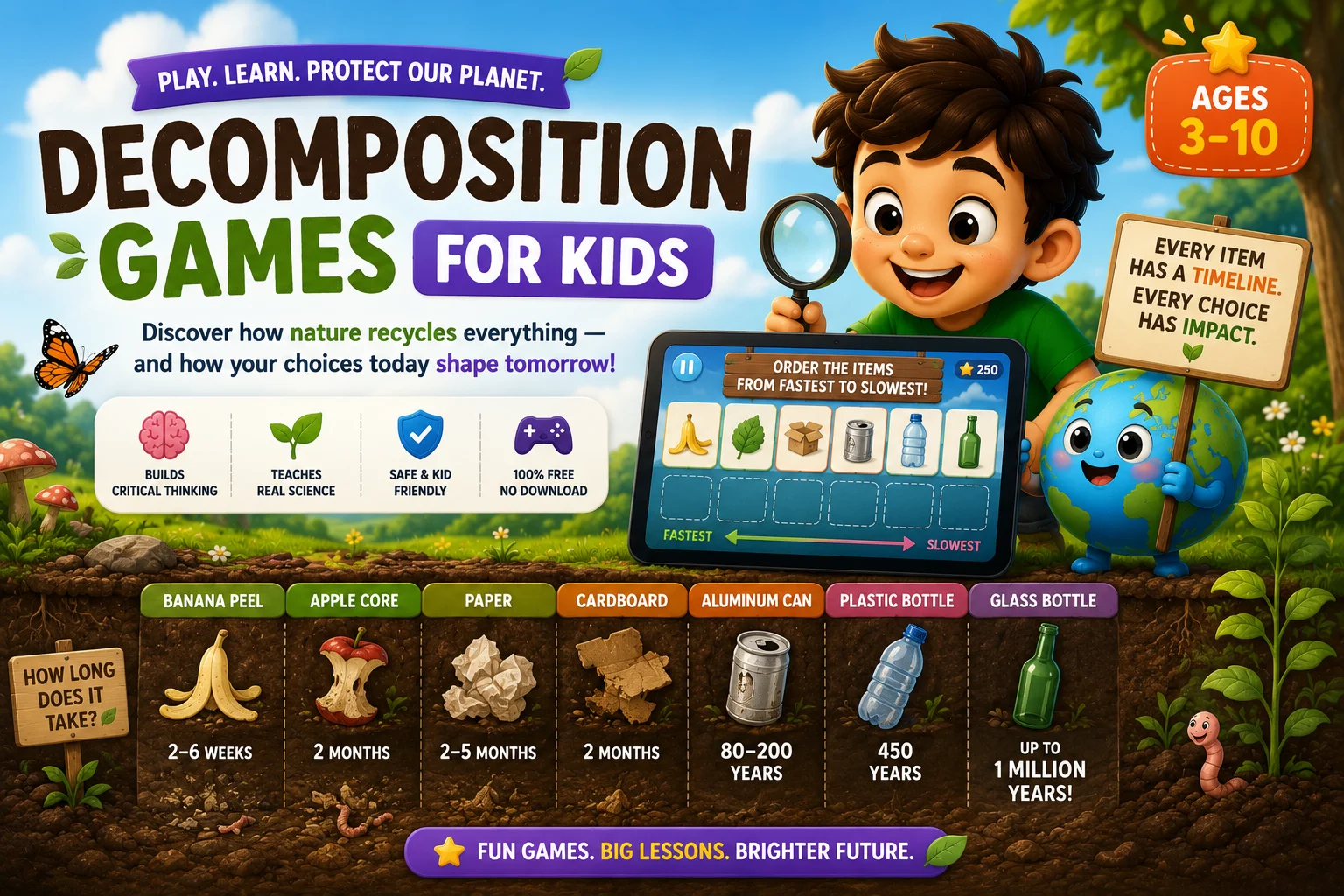
Decomposition is the fact underneath almost every other eco topic — why plastic is such a problem, why landfills keep growing, why a "small" piece of litter is actually a decades-long problem. A few concrete numbers make it click fast.
2–5 wks
for a banana peel to fully break down when composted
8 wks
for an apple core to biodegrade after being tossed
80–200 yrs
for an aluminum can to fully decompose, if never recycled
450 yrs
is a commonly cited estimate for a plastic bottle to break down
Decomposition timelines vary widely by environment (buried vs. exposed, dry vs. wet) and by study; ranges reflect commonly cited estimates as of 2026.
Here's the number that tends to land hardest with kids: a glass bottle is estimated to take up to a million years to fully break down. Not hundreds of years — over a thousand times longer than the plastic bottle above. That single comparison usually does more teaching than an entire lecture on recycling.
Some trash outlives every person who will ever throw it away — and a good decomposition game is the fastest way for a kid to actually feel that.
5 free play sessions, ranked by age
Each of these is a full session: 4–10 minutes of play, plus a conversation starter you can use word-for-word. Start with whichever one matches your kid's age, then space the rest out over the week.
1. Biodegradable Bubble — the direct hit
This free browser game has kids watch materials decompose in a time-lapse, then drag them into order from fastest to slowest: cotton shirt, newspaper, apple core, banana peel. It's the single clearest, most direct way to teach the comparison skill this whole topic runs on.
Play Biodegradable Bubble free →
Play together, no download needed
Turn this into your kid's go-to eco game shelf
Biodegradable Bubble is one game in HelloHiDear's free Waste & Recycling series — short, browser-based games that connect trash, timelines, and everyday habits for kids ages 5–10. No account, no ads between rounds, just play.
Browse the full games library →2. Landfill Lifter — where slow-decomposing trash actually piles up
Once a kid understands that some materials barely break down, this game shows the consequence: a landfill pile that keeps growing because so much of what goes in stays basically unchanged for decades. It connects the timeline lesson to a real physical place.
3. Electronic E-Waste — the stuff that barely decomposes at all
Electronics are one of the slowest-decomposing, most persistent categories of waste there is, packed with metals and plastics that don't break down on any timeline a kid can picture. This game shows why taking devices apart responsibly matters more than most trash decisions.
Play Electronic E-Waste free →
4. Leave No Trace's trash timeline — the real research version
Once your kid has the game-based basics down, this free resource from the outdoor nonprofit Leave No Trace lays out researched decomposition timelines for dozens of common items — a good "why do scientists actually know this" session for older kids who want more depth.
Explore the Leave No Trace trash timeline →
5. Reflection Reject — a calm wind-down round
Not every session needs to be about timelines and centuries. This quick pattern-spotting game is a good closer after a few rounds of "this outlives you" facts — a lighter way to end the session. Kids process heavier topics better with a breather in between.
Screen game vs. craft vs. story: which fits your kid
Decomposition is genuinely fun to explore hands-on, not just on a screen. Here's how to match the format to your kid's attention span this week.
| Format | Best for | Time needed | Where to start |
|---|---|---|---|
| Online game | Kids who want quick wins and instant feedback | 4–10 min | HelloHiDear games |
| Real experiment | Kids who learn best by watching it happen | Ongoing, weeks | Bury a banana peel and a plastic wrapper in two labeled jars of soil and check weekly |
| Reference reading | Older kids (ages 8–12) who want more depth | 10–15 min | Leave No Trace trash timeline |
| Bedtime conversation | Reinforcing what a game already taught | 2–5 min | Use the "ask after playing" scripts above |
If you only have five minutes today, the online game wins every time. But if your kid gets hooked on the "which one wins the race" idea, the real jar experiment is worth the few weeks it takes — nothing beats watching it happen for real.
- 🍌 Lead with comparison, not raw numbers — "faster or slower than" lands better than "450 years" on its own.
- 🍌 Say the follow-up question out loud, even if the answer is "I don't know." That's still the conversation working.
- 🍌 Let a lighter game close out a heavy timeline fact so kids don't associate learning with feeling bad.
- 🍌 If you start the jar experiment, check in on it together weekly — the waiting is part of the lesson.
Parent FAQ
What age should kids start learning about decomposition?
Around age 7 is when most kids can compare timespans meaningfully, which is what decomposition really is: a race between materials over weeks, years, or centuries. Games that let kids order items from fastest to slowest to break down work well for ages 7 to 10.
How long does it actually take common items to decompose?
Roughly: a banana peel takes a few weeks to a couple of years, an apple core about 8 weeks, an aluminum can 80 to 200-plus years, a plastic bottle around 450 years, and a glass bottle up to 1 million years. Exact timelines vary by source and environment.
Why does decomposition matter for kids to understand?
It's the concept that connects a single choice, like using a reusable water bottle instead of a plastic one, to a timeline a kid can actually picture. Understanding that plastic outlasts several human lifetimes reframes "just one bottle" into something more concrete.
Are these decomposition games free with no sign-up?
Yes. Every HelloHiDear game linked in this guide plays free in a browser with no account or download required.
Written by the HelloHiDear editorial team, who build and test every free game linked on this site. Decomposition timelines reviewed against published estimates as of July 2026; actual rates vary by environment. See something outdated? Let us know.