🪱 Here's the short version
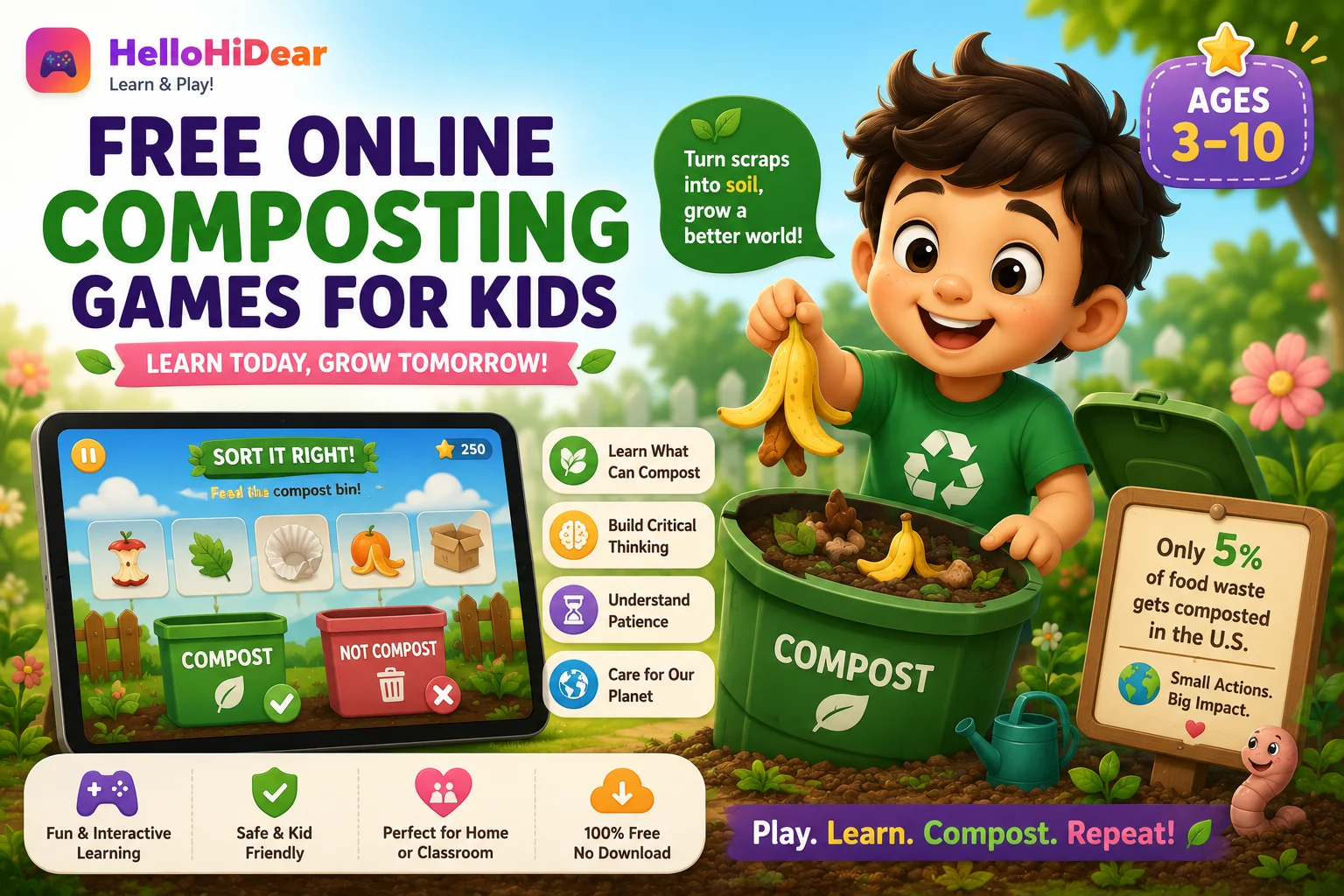
Only about 5% of U.S. food waste actually gets composted, and that matters more than it sounds — food waste rotting in a sealed landfill produces methane, a serious greenhouse gas, while composting (which happens with oxygen) mostly avoids that. The tricky part for young kids isn't understanding this — it's the wait. Composting has a long feedback loop, and the ability to wait weeks for a payoff develops gradually. Start with the sorting decision, which is immediate and game-friendly.
Just want the game? Jump straight to it →The surprising problem with "natural" food waste
A banana peel feels harmless to toss in the regular trash — it's natural, right? Here's the part that surprises most parents: where it ends up changes everything.
66.2M tons
of food wasted across US retail, food service & homes in 2019
Source: EPA
Only 5%
of that wasted food was actually composted
Source: EPA
58%
of landfill methane emissions come from wasted food alone
Source: EPA
Here's the actual mechanism, and it's honestly a fun thing to explain with a kid: in a sealed landfill, food waste is packed down with no oxygen. Bacteria break it down anaerobically (without air), and that process releases methane — a much more powerful greenhouse gas than the carbon dioxide most people worry about. Composting works differently: it happens with oxygen, which mostly skips that methane step entirely. Same banana peel, wildly different outcome, just based on where it goes.
Why composting is genuinely hard to teach a 4-year-old (and it's not their fault)
Composting has a long feedback loop. Your kid sorts the banana peel into the right bin today, but the "reward" — finished compost, a garden that grows better — is weeks or months away. Waiting that long for a payoff is a real developmental stretch for a young kid.
The bottom line: the ability to wait for a bigger, later reward instead of a smaller, immediate one strengthens gradually across early-to-middle childhood — it's not something to expect fully formed from a preschooler. That doesn't mean skip composting with young kids. It means start with the part that's immediate and satisfying: does this go in the compost or not? That's a sorting decision, and it's exactly what games are good at.
Play it: practice the sorting part first
There isn't a dedicated composting game yet, but this one covers the exact skill that matters most before the real waiting game begins: recognizing what actually breaks down, and how fast.
Biodegradable Bubble
Kids watch materials decompose in a time-lapse and rank them fastest to slowest — the exact judgment call composting depends on. It's the "which of these actually belongs in the compost pile" instinct, minus the multi-week wait.
Opens right in your browser. No account, no install, nothing to buy.
Want the soil-health payoff without the wait? Landfill Lifter ties waste decisions directly to keeping soil healthy — a nice bridge to why composting matters in the first place.
How long should they actually play? Here's what pediatricians say
The AAP doesn't give "educational" games a free pass on screen time — quality of interaction matters most. In plain terms:
- Under 18 months: Video chats with family, that's about it.
- Ages 2–5: Around one hour a day of good content, ideally with you nearby.
- Ages 6–10: Less about a strict clock, more about a family plan that balances screens with everything else.
💬 A real starter activity
- Set up a small countertop caddy for one week — no yard needed. Let your kid decide what goes in.
- "Why do you think this banana peel goes here and not the trash?"
- "What do you think will happen to it in a month? Let's check back and see who was right."
Game vs. kitchen caddy vs. backyard bin — an honest comparison
🔍 Three ways to practice composting
| Method | Good for | Watch out for |
|---|---|---|
| Online sorting game | Immediate feedback, zero smell, zero mess, no wait required. | Doesn't teach the real multi-week process. |
| Kitchen countertop caddy | Works in any home, apartment-friendly, builds the daily habit. | Needs somewhere to actually take it — curbside pickup or drop-off. |
| Backyard compost bin | The full real experience, including the payoff — finished compost. | Requires yard space and genuinely takes patience over weeks. |
3 composting myths, busted
"Throwing a banana peel in the regular trash is basically fine — it's natural."
In a sealed landfill, that same peel breaks down anaerobically and contributes to methane emissions — food waste alone accounts for over half of landfill methane. Natural doesn't mean neutral once it's buried without air.
"Composting is only for people with big yards and gardens."
Countertop caddies, apartment-friendly systems, and community drop-off programs all count — no yard required.
"If my kid loses interest in composting fast, they just don't care about it."
Composting is a long-feedback-loop activity, and patience for delayed rewards is still developing at that age. Start with the immediate sorting decision — the patience piece comes later.
More free games, by age and skill
If ranking decomposition speed clicked, these build related skills:
Sorting · Ages 4–8
Landfill Lifter
Waste decisions tied directly to keeping soil healthy.
Sorting · Ages 4–8
Electronic E-Waste
A gentler single-decision sorting game to build the basics.
Observation · Ages 5–9
Reflection Reject
Spot-the-difference that builds attention to detail.
Full library
Browse all free games
Every game, organized by age and the skill it actually builds.
Where these numbers came from
We didn't make any of this up — here's the receipts:
- US EPA. "Composting." epa.gov
- US EPA. "Food: Material-Specific Data." epa.gov
- US EPA. "Quantifying Methane Emissions from Landfilled Food Waste." epa.gov
- AAP, via HealthyChildren.org. "Where We Stand: Screen Time." healthychildren.org