🍃 Here's the short version
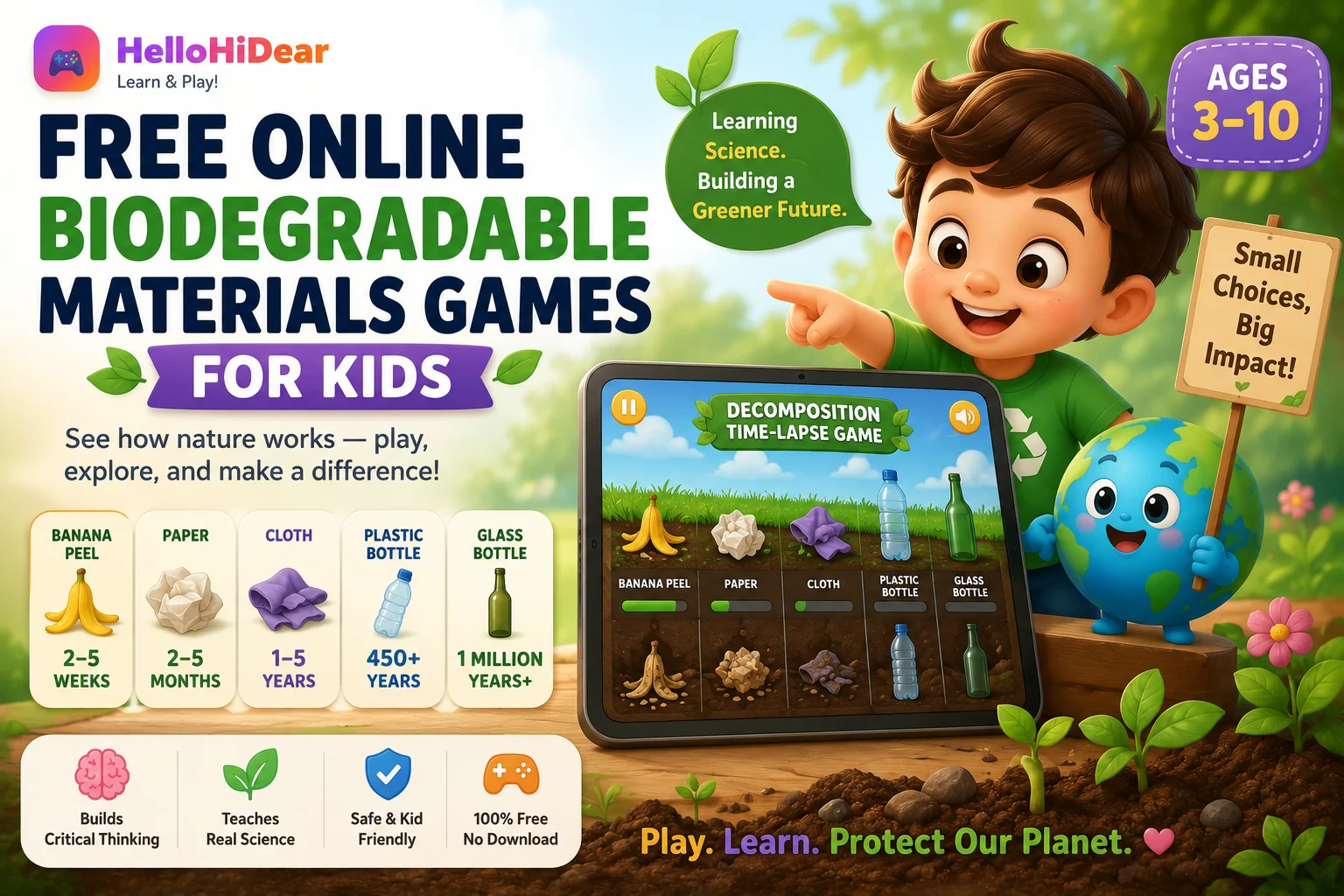
"Biodegradable" doesn't automatically mean "breaks down fast." The FTC actually requires companies to prove a biodegradable product fully decomposes within a year of normal disposal — and even then, a sealed landfill with no oxygen or sunlight can barely break down anything, biodegradable label or not. Meanwhile, young kids genuinely struggle to picture spans of time longer than "a really long time," which is exactly why a fast time-lapse teaches this better than a number on a chart. Try one below.
Just want the game? Jump straight to it →The "biodegradable" label trap
Here's a fact that surprises most parents: putting "biodegradable" on a package is a legal claim, not just a marketing word. The FTC's Green Guides require the company to prove the entire product will fully break down into natural elements within one year of normal disposal.
The FTC has actually gone after companies for this — fining and restricting several in recent years for claiming plastic products were biodegradable without real evidence backing it up.
~3–5 weeks
for a banana peel to break down under good composting conditions
Source: USDA Forest Service
10–20+ yrs
for a plastic bag — estimates vary a lot depending on the source
Source: multiple environmental studies
~1M years
often cited for a glass bottle — some say it never fully breaks down
Source: USDA Forest Service
Notice those ranges. Different reputable sources give genuinely different numbers for the same item, and that's not sloppy science — it's because decomposition depends enormously on where something ends up: sunlight, oxygen, moisture, temperature, all of it changes the timeline. A sealed landfill is airless and dark, which means even something legitimately biodegradable can sit there far longer than the "biodegradable" label implies.
So what age can kids actually grasp "takes 500 years"?
Here's the part that isn't really about trash at all — it's about how kids understand time. A number like "200 years" doesn't mean much to a 4- or 5-year-old. A year already feels enormous at that age. This isn't a gap in your kid's understanding; it's just where the timeline of that skill normally sits — a firmer grasp of long, abstract stretches of time develops gradually across the elementary years, not before.
The bottom line: a compressed time-lapse — watching something visibly decompose faster or slower than something else, sped up into seconds — teaches the actual comparison a young kid can grasp, well before "200 years" means anything real to them. The number becomes meaningful later, closer to age 8–10.
Play it: a time-lapse game built around this exact idea
This game skips the abstract numbers entirely and lets kids watch the comparison happen.
Biodegradable Bubble
Kids watch different materials decompose in a fast time-lapse, then put them in order from fastest to slowest. No years, no numbers required — just a felt sense of "this goes way before that," which is exactly the comparison that sticks at this age.
Opens right in your browser. No account, no install, nothing to buy.
Younger kid, or want to build the underlying sorting skill first? Landfill Lifter practices a simpler decision — recyclable or not — before adding the "how long does it take" layer.
How long should they actually play? Here's what pediatricians say
The AAP doesn't give "educational" games a free pass on screen time — the quality of interaction matters most. In plain terms:
- Under 18 months: Video chats with family, that's about it.
- Ages 2–5: Around one hour a day of good content, ideally with you nearby.
- Ages 6–10: Less about a strict clock, more about a family plan that balances screens with everything else.
💬 A real experiment to try together
- Bury or bag a banana peel and a piece of plastic wrap side by side outside. Check weekly — which one changes first?
- "Which one do you think will still look the same in a month? Why?"
- "Does 'natural' always mean 'disappears fast'? Let's find out."
Game vs. real backyard experiment vs. a timeline chart — an honest comparison
🔍 Three ways to teach decomposition
| Method | Good for | Watch out for |
|---|---|---|
| Online time-lapse game | Instant, felt comparison — no waiting weeks for a real result. | Doesn't show real-world variables like weather or soil type. |
| Real backyard experiment | The most concrete, believable version — your kid sees it happen. | Takes actual weeks; needs a little patience and follow-through. |
| Printed timeline chart | Good reference for older kids (8+) who can handle the numbers. | Numbers like "450 years" mean very little before that age. |
3 biodegradable myths, busted
"If it says biodegradable, it'll disappear quickly in the trash."
The FTC requires a full-year decomposition claim to be backed by evidence — but sealed, airless landfills can barely break anything down, biodegradable label or not. The material matters less than the environment it ends up in.
"Natural stuff like banana peels are basically harmless litter."
Even "fast" decomposers take weeks to break down, and littered food scraps can still attract pests or affect wildlife in the meantime. Natural doesn't mean instant or impact-free.
"My 3-year-old should already understand why plastic takes so long to break down."
Grasping truly long, abstract time spans is a skill that develops gradually through the elementary years — not something to expect from a preschooler. A time-lapse comparison works with where they actually are.
More free games, by age and skill
If ranking decomposition speed clicked, these build related skills:
Sorting · Ages 4–8
Landfill Lifter
Recyclable-or-not sorting, plus a soil-health angle.
Sorting · Ages 4–8
Electronic E-Waste
A gentler single-decision sorting game to build the basics first.
Observation · Ages 5–9
Reflection Reject
Spot-the-difference that builds attention to detail.
Full library
Browse all free games
Every game, organized by age and the skill it actually builds.
Where these numbers came from
We didn't make any of this up — here's the receipts:
- USDA Forest Service. "Junior Explorer Trash Timeline." fs.usda.gov
- Federal Trade Commission. "FTC Cracks Down on Misleading and Unsubstantiated Environmental Marketing Claims." ftc.gov
- AAP, via HealthyChildren.org. "Where We Stand: Screen Time." healthychildren.org